Tokens: AI reads chunks, not letters
AI doesn't read your text letter by letter. It sees numbered chunks of text called tokens.
The short answer
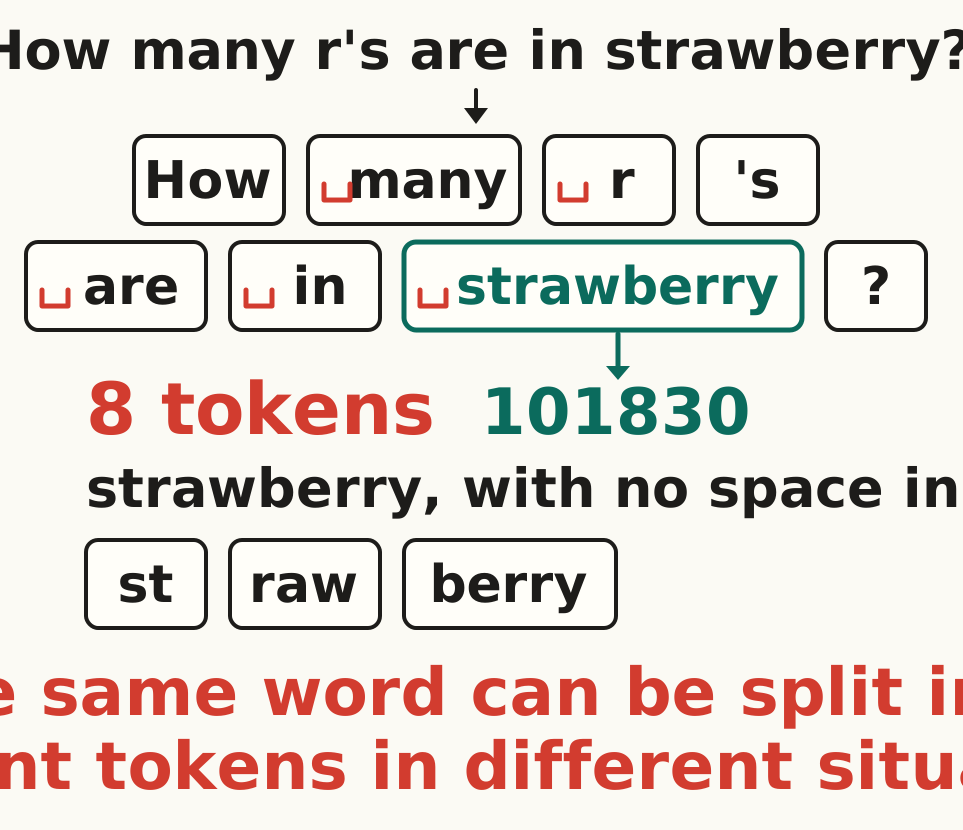
A tokenizer cuts your text into chunks called tokens. A token can be any piece of text from a letter to a full word, even characters or chunks of text, like 'ing'. The model gets each token as a number from a fixed list. In OpenAI's o200k_base tokenizer, "How many r's are in strawberry?" is 8 tokens.
The picture
How it works
A tokenizer is a program that builds the fixed list from text before the model is trained, then turns your text into numbered tokens every time you use the model. Common words get a token of their own, and rare words are built from smaller pieces (Sennrich et al., section 3.2). OpenAI's o200k_base list has about 200,000 tokens, and tiktoken uses it for GPT-4o. The older cl100k_base list has about 100,000, and tiktoken uses it for GPT-4.
Each model's makers choose the size of its list. Meta's Llama 3.1 8B, a small model, has about 128,000 tokens on its list. Moonshot's Kimi K3, one of the biggest models anyone can download, is about 350 times bigger, but its list has only about 164,000.
In the question, each word after the first carries the space before it. That is why " strawberry" starts with a space, and with it the word is one token. Without the space, the word splits into three tokens. In o200k_base they are "st", "raw" and "berry". In cl100k_base they are "str", "aw" and "berry", and " strawberry" is token 73700. Each tokenizer cuts text its own way.
So the model is never handed the ten letters of strawberry to count. It is handed one number, or in the case of strawberry typed without a space, it receives three numbers, one for each token.
Try it
Paste this into Python 3, after pip install tiktoken. The first run downloads each tokenizer's list, so it needs the internet.
# Token numbers in two OpenAI tokenizers, from OpenAI's tiktoken library.
import tiktoken
for name in ["o200k_base", "cl100k_base"]:
    enc = tiktoken.get_encoding(name)
    print(name)
    print(len(enc.encode("How many r's are in strawberry?")), "tokens")
    print("' strawberry' =", enc.encode(" strawberry"))
    print("'strawberry' =", [enc.decode([t]) for t in enc.encode("strawberry")])
What you should see:
o200k_base
8 tokens
' strawberry' = [101830]
'strawberry' = ['st', 'raw', 'berry']
cl100k_base
8 tokens
' strawberry' = [73700]
'strawberry' = ['str', 'aw', 'berry']
Both tokenizers make 8 tokens of the question, but they number and split the word differently.
Simplified on purpose
- “AI doesn't read your text letter by letter.”
I said AI doesn't read letter by letter. That's true for the AI you chat with, but a rare word can still break down into single letters, and a few research models read text byte by byte. - “Moonshot's Kimi K3, one of the biggest models anyone can download, is about 350 times bigger, but its list has only about 164,000.” (How it works)
When I say Kimi K3 is about 350 times bigger, I mean it has about 350 times as many parameters, the numbers a model learns. Its download is only about 100 times bigger, because it stores those numbers compactly. - “So the model is never handed the ten letters of strawberry to count.” (How it works)
I said the model is never handed the letters. That's true when you type strawberry as a word. Type it as s-t-r-a-w-b-e-r-r-y, or let the AI spell it out first, and it gets them one at a time.
Sources and checks
- OpenAI, tiktoken (github.com/openai/tiktoken). The two tokenizers, and which model uses each: tiktoken/model.py.
- Sennrich et al. (2016), Neural Machine Translation of Rare Words with Subword Units. How a token list is built from text: section 3.2.
- Meta, Llama 3.1 8B: its config.json (vocab_size), read from a public copy (huggingface.co/unsloth/Meta-Llama-3.1-8B), since Meta's own copy needs a login.
- Moonshot AI, Kimi K3 (huggingface.co/moonshotai/Kimi-K3): its config.json (vocab_size) and model card (2.8T parameters).
Computed by check.py: the 8 tokens, the token numbers 101830 and 73700, the three-way splits, the two list sizes, the ten letters, the Llama and Kimi list sizes and parameter counts (read from Hugging Face), and which model tiktoken maps to each list.
How this was checked (2026-10-07, the Llama and Kimi numbers 2026-10-25): check.py ran tiktoken 0.14.0 on Python 3.11. Which model uses which list is tiktoken's own table, not OpenAI's model pages.
License
Words, picture, Reel and music: CC0 1.0. Code: MIT-0. Copy, change and share anywhere, with no credit needed.